
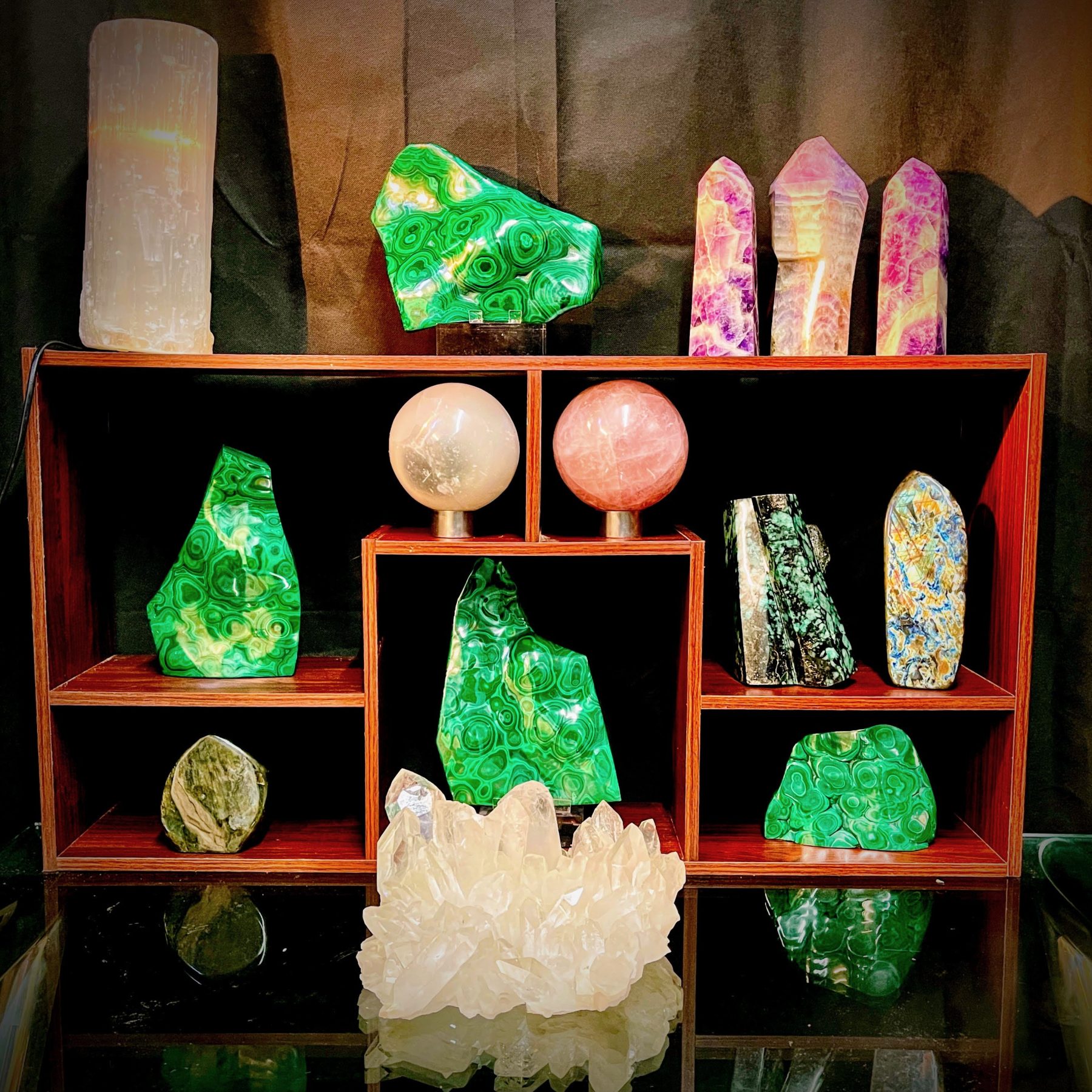
Ever picked up a beautiful stone and wondered whether it would survive daily life on a shelf, a ring, or a coffee table? There’s a 200-year-old trick for that, and it’s simpler than you’d think: the Mohs hardness scale.
A Scratch Test From 1812 That Never Got Replaced
In 1812, a German mineralogist named Friedrich Mohs came up with a wonderfully low-tech way to rank minerals: he scratched them against each other. His logic was simple — a harder mineral will scratch a softer one, but not the other way around. So he lined up ten common minerals from softest to hardest, gave each one a number from 1 to 10, and just like that, collectors had a shared language for describing durability.
The line-up still used today runs: talc (1), gypsum (2), calcite (3), fluorite (4), apatite (5), orthoclase feldspar (6), quartz (7), topaz (8), corundum — which includes ruby and sapphire — (9), and diamond (10). Talc is so soft you can scratch it with a fingernail. Diamond is so hard almost nothing else touches it, which is exactly why it ended up on the tip of industrial cutting tools as well as engagement rings.
It’s worth knowing this isn’t a scale of “how many times harder” — it’s just relative ranking. Diamond isn’t twice as hard as topaz just because 10 is twice 5; in reality the jump from corundum to diamond is enormous compared to the smaller steps lower down the scale. Think of it more like a pecking order than a ruler with even marks.
The neat part is you don’t need Mohs’ original mineral kit to use this at home. Everyday objects sit at roughly known points on the scale: a fingernail is about 2.5, a copper coin around 3.5, a steel knife blade or window glass about 5.5, and a steel file close to 6.5. Try to scratch an unfamiliar stone with each in turn, and you can narrow down what you’re likely holding before you ever look it up.
Why This Actually Matters Once You’re Buying or Displaying
This isn’t just trivia for geology nerds — it has very real consequences for anyone who owns a piece. If you’re picking out a statement stone for a coffee table, a soft mineral like calcite or selenite (both around 2-3) will scratch if keys or coins are set down on it carelessly, while quartz or amethyst (7) will shrug that off for decades. If you’re buying jewellery, this is exactly why opal and turquoise rings need more careful wearing than a sapphire one — softer stones simply pick up wear faster.
For collectors, hardness is also one of the first clues toward identifying an unlabelled specimen. Colour and shape can fool you — plenty of unrelated minerals share a similar look — but hardness is a genuine physical property that’s hard to fake. Pair a scratch test with a look at the crystal shape and you’re most of the way to a confident ID.
It’s a good reminder that every piece in a collection or on a shelf has its own physical personality — some are tough enough for daily handling, others are better admired than touched. Knowing which is which means fewer disappointed scratches and a lot more informed appreciation.
Next time you’re in the shop, ask us where a piece sits on the scale — it’s one of the quickest ways to know how to live with it, whether that means a coffee table centrepiece or a case for careful display only.