
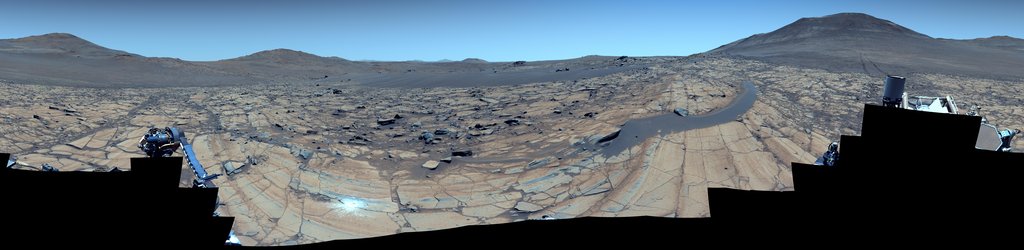
Now and then the mineral world gets a genuinely new entry — and this time it didn’t turn up in a quarry or a cave, but on Mars.
A team led by Dr. Janice Bishop at the SETI Institute, working with NASA’s Ames Research Center, has spotted a mineral that’s never been seen before: an iron-bearing sulfate they’re calling ferric hydroxysulfate. They found it in a canyon system called Valles Marineris, one of the biggest in the solar system, hiding in layers of much older sulfate rock.
So How Do You Find a New Mineral on Another Planet?
Mars is bone dry, which actually works in scientists’ favour — minerals that would wash away in Earth’s rain just sit there for billions of years instead, like a sealed time capsule. By comparing satellite readings of Mars with the same minerals recreated in a lab, the team worked out that this particular mineral only forms when older sulfate minerals get baked at high heat with a bit of oxygen around. Mars’ surface doesn’t get anywhere near that hot on its own — so something underground, likely an old volcanic or geothermal hotspot, must have done the heating, probably within the last three billion years (which, on a planetary timescale, is fairly recent).
That’s the real-world significance here: it’s evidence that Mars wasn’t just geologically “dead” the moment it dried up. Pockets of heat and water chemistry were still active long after most of the planet went quiet — exactly the kind of environment scientists look for when asking whether Mars could once have supported life. It also means there’s likely more of this mineral still buried and waiting to be found.
One small asterisk: a mineral isn’t officially added to the books until it also turns up naturally on Earth. So for now, this is a very strong candidate rather than a confirmed new mineral — geologists will be hunting for an earthly match.
Why It’s Worth a Second Look If You Collect
You don’t need a rover to find the family resemblance. Sulfates are everyday minerals on a collector’s shelf — gypsum and hematite are common examples, and you’ve probably handled both. What just happened on Mars is the same basic chemistry: water, heat, and time, acting on the same kinds of minerals we already display at home. Mars has just had three billion quiet, undisturbed years to do it in.
It’s a nice reminder of why mineral collecting never gets old — every specimen is a little record of the exact conditions that made it, and those conditions never come around twice. Whether it formed in a Martian canyon or a Derbyshire cave, that’s the appeal.
Next time you’re in, ask us about the formation story behind any piece on the shelves — there’s usually more going on than meets the eye.
